New Brighton Beach
Barrier beach · Deposition landform · SECCE
The landform
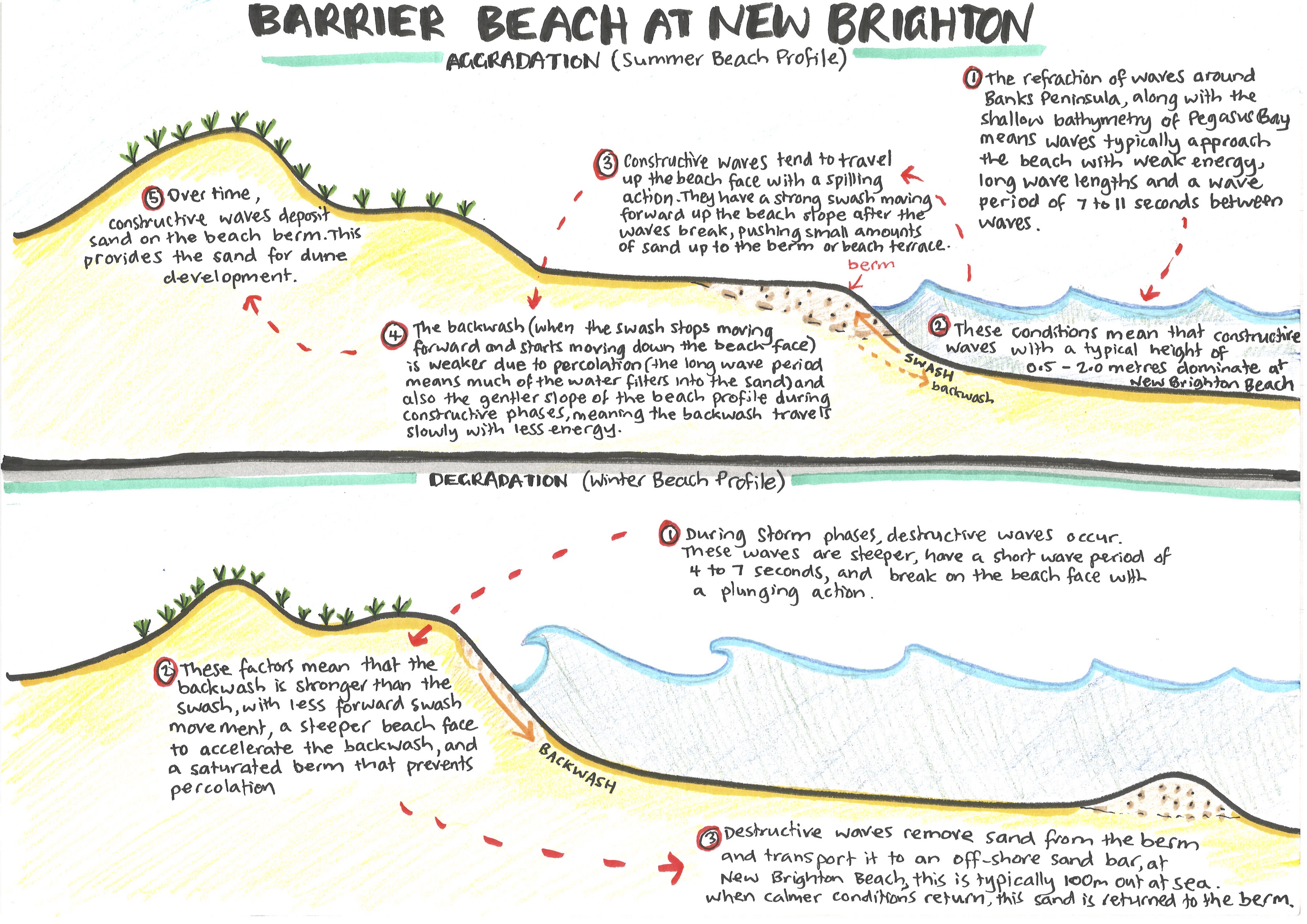
New Brighton Beach is a barrier beach that builds up and is worn back as constructive and destructive waves take turns.
Aggradation (summer beach profile)
The refraction of waves around Banks Peninsula, along with the shallow bathymetry of Pegasus Bay, means that waves typically approach the beach with weak energy, long wavelengths and a wave period of 7 to 11 seconds. These conditions mean that constructive waves with a typical wave height of 0.5 to 2.0 metres dominate at New Brighton Beach.
Constructive waves tend to travel up the beach face with a spilling action. They have a strong swash moving forward up the beach slope after the wave breaks, pushing small amounts of sand up to the berm or beach terrace.
The backwash (when the swash stops moving forward and starts moving down the beach face) is weaker due to percolation (the long wave period means much of the water filters into the sand) and also the gentler slope of the beach profile during constructive phases, meaning the backwash travels slowly with less energy.
Over time, constructive waves deposit sand on the beach berm. This will provide the sand for dune formation.
Degradation (winter beach profile)
During storm phases, destructive waves occur. These waves are steeper, have a shorter wave period, and break on the beach face with a plunging action.
These factors mean that the backwash is stronger than the swash, with less forward swash movement, a steeper beach face to accelerate the backwash, and a saturated berm that prevents percolation.
Destructive waves remove sand deposits from the berm and transport the sediment to an offshore bar around 100 m out at sea.
When calmer conditions return, this sand transfer reverses.
The diagram
Fact file
- Landform
- Barrier beach
- Type
- Deposition feature
- Processes
- Wave refraction · Wave deposition · Wave erosion · Wave transportation · Aggradation · Degradation
- Key facts
- Constructive waves 0.5 to 2.0 m high, wave period 7 to 11 seconds · Destructive waves have a wave period of 4 to 7 seconds · Offshore bar around 100 m out
Using it in the exam
Question A (how processes shaped the environment): the barrier beach at New Brighton is one of the deposition features you can choose from. On your map, label it with its landform type and place name, and add a short caption, for example:
“Long barrier beach built up by constructive waves, with dunes behind it.”
Question C (spatial variation): New Brighton and Taylors Mistake are both beaches affected by constructive and destructive waves. However, the barrier beach at New Brighton has longshore drift and a sediment supply from the Waimakariri River, creating a spit at the end of the beach, while Taylors Mistake is a pocket beach with a closed sediment system.
Temporal variation: the difference between summer and winter beach profiles (the shape of the beach slope above and below the water) is an example of temporal variation.